Technical analysis by norok about Symbol XMR: Buy recommendation (12/17/2025)

Monero: "Delisting is a Feature"
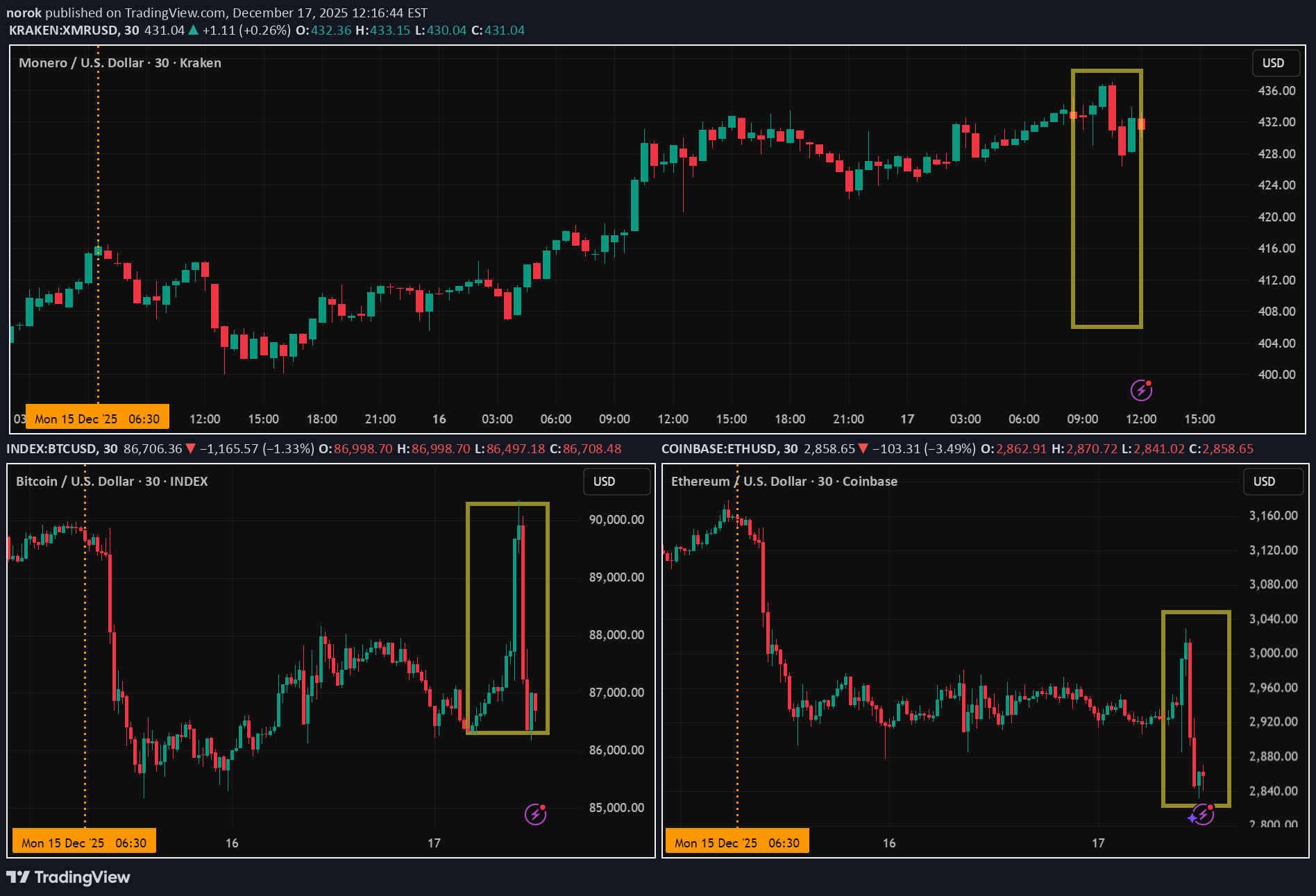
What if NOT being listed on major Centralized Exchanges is Monero's greatest bull case? Most investors assume the same thing: Assets go up because they attract speculative capital. Liquidity, listings, leverage, and visibility are treated as prerequisites for valuation. So Monero’s biggest “problem” — being delisted from major centralized exchanges due to its privacy guarantees — is usually framed as fatal. But what if that assumption is backward? What if removal from the speculative casino is precisely why Monero behaves differently — and arguably better — than the rest of crypto? The common criticism (and why it persists) The standard argument goes like this: Monero’s privacy features make it non-compliant with evolving regulations. That forces centralized exchanges to delist it. Without exchange access, speculative inflows dry up. Without speculation, price stagnates. That narrative has circulated for years. It sounds logical. It’s also increasingly contradicted by reality. Despite repeated delistings, Monero has emerged as one of the most uncorrelated assets in the entire crypto market. And correlation — not volatility — is what quietly destroys portfolios. What the charts are actually showing BTCUSD ETHUSD SOLUSD DOGEUSD XRPUSD This morning’s sharp up/down move rippled across crypto almost uniformly. Bitcoin, Ethereum, Solana, Doge, XRP — all displayed the same pattern: A volatility spike A break from bearish consolidation A quick rejection back into the range or lower It was a textbook “low-volume volatility quake.” Monero barely reacted. While the rest of the market moved as a single organism — pushed and pulled by the same algos, market makers, and thin liquidity — Monero’s bullish trend remained largely uninterrupted. When everything moves together except one asset, that exception matters. The delisting that changed the story On February 6, 2024, Monero dropped over 30% overnight. At first, I assumed the worst — a cryptographic failure or privacy compromise. Instead, the cause was simple: Binance delisted Monero for regulatory non-compliance with privacy coins. In other words, Monero was punished for working exactly as designed. I held. This ended up being a market reaction quickly abated and Monero has rallied over 300%. The selloff faded quickly. Since that low, Monero has rallied more than 300%. Being removed from the highest-volume exchange did not suppress Monero’s value. If anything, it may have liberated it. The overlooked mechanism Most cryptocurrencies are now: Heavily centralized around exchanges Continuously arbitraged Priced primarily through leverage and relative flows That makes them efficient — and tightly correlated. Monero exists increasingly outside that system. With fewer algos, less leverage, and limited access to reflexive speculation, Monero’s price is influenced more by: Actual usage Holder conviction Intrinsic demand for private settlement That doesn’t make it exciting every day. It makes it structurally different. And markets eventually reward assets that don’t break the same way everything else does. A thought worth sitting with Most people believe delistings remove value. That belief feels obvious — until you watch an asset stop reacting to the same forces that destabilize everything else. Monero may not be underperforming because it lacks speculation. It may be outperforming because it no longer depends on it. In a market addicted to correlation, independence is not a bug. It’s the feature everyone overlooks — right up until it matters.