تحليل التحليل الفني Swissquote حول BTC في رمز في 26/11/2025

Swissquote
رمزگشایی بازار خرسی بیت کوین: چه چیزی را باید بدانید؟
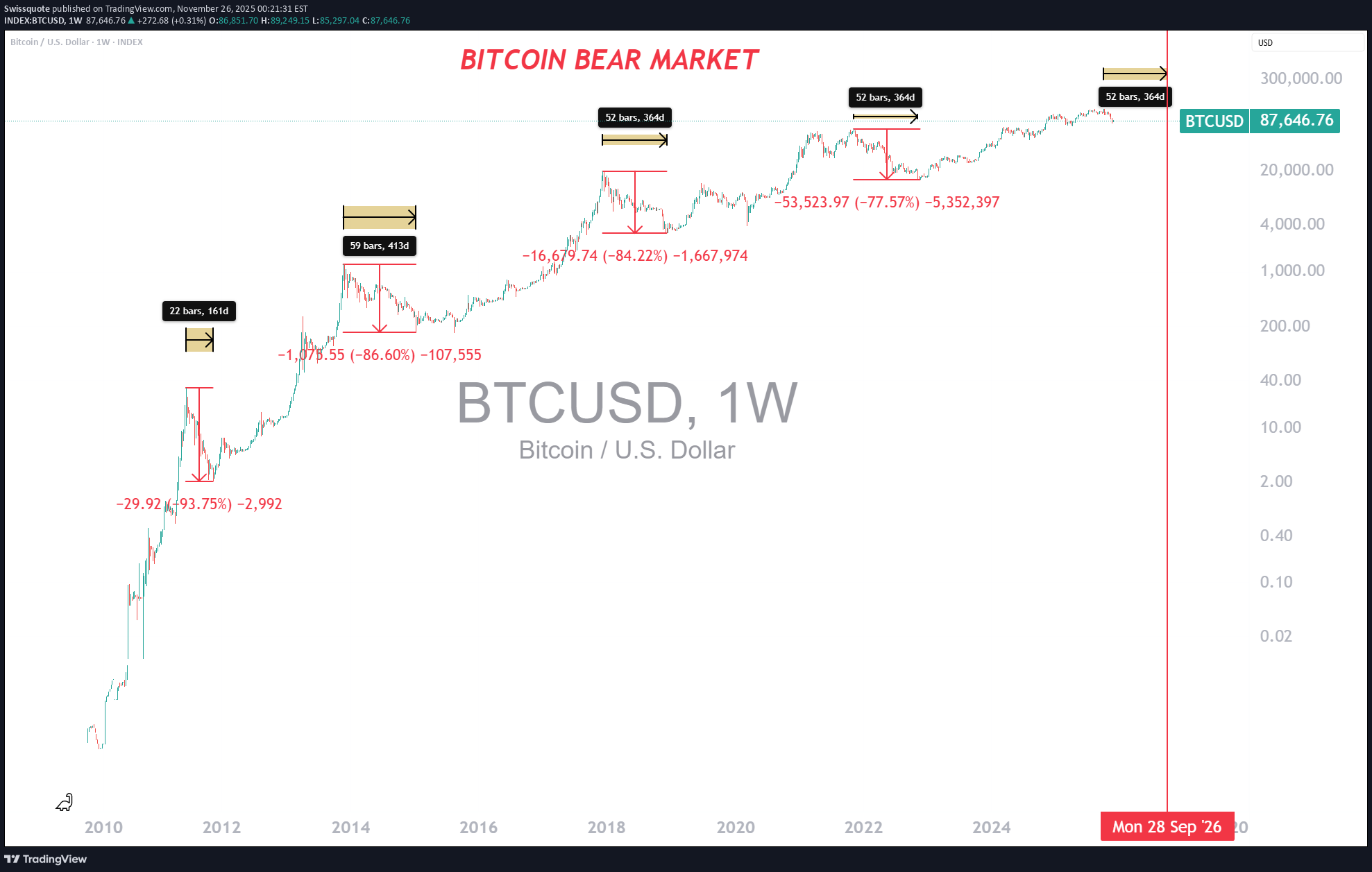
Under the credible, and now widely discussed, hypothesis that Bitcoin’s last bullish cycle ended on Monday, October 6, at a peak around 126,000 USD, it becomes logical to consider that the market then entered its new cyclical bear market. This bear market is part, as always, of the well-known 4-year cycle dynamic, itself directly linked to the quadrennial halving mechanism, which halves the mining reward and mechanically reduces the new supply of BTC. In other words, the market follows a structural breathing pattern: four years built around a supply shock, a bullish acceleration, and then a normalization marked by a bearish phase. By printing a cycle top at the very beginning of October, Bitcoin has therefore confirmed, in an almost surgical manner, that the mechanics of the 4-year cycle remain fully active. We now have enough statistical hindsight to understand not only how the bullish phase of a cycle behaves, but also how the cyclical bear market unfolds, with regularities strong enough to serve as a robust analytical framework. Here is what we know about the dominant technical factors of this bear market: •Average duration: a cyclical Bitcoin bear market lasts around 12 months. It’s a remarkably stable constant from one cycle to the next. •Price structure: the bear market generally consists of three major waves. A first impulsive and strongly negative wave (the one we would have entered since October 6), followed by a technical rebound phase, often referred to as a dead cat bounce, and finally a third and last bearish leg, which brings the true cycle bottom. •Drawdown amplitude: from one cycle to another, the maximum depth of the decline tends to shrink. Nevertheless, even while decreasing, the drawdown remains historically substantial, and must be understood as a major correction rather than a simple pullback. (For those wishing to dig deeper into this point, see our analysis from Monday, November 17, 2025.) Assuming therefore that the cyclical bear market effectively began on October 6, logic would suggest that it should continue until September or October 2026. It should unfold according to the three technical phases mentioned above, before potentially recording a final drawdown somewhere between 50% and 70% from the 126,000 USD peak. Naturally, this scenario remains theoretical. It relies solely on the presumed validity of the quadrennial cycle. If the latter were to turn out to be nothing more than a statistical illusion, a historical artifact, or a now obsolete phenomenon, then this entire analytical framework would also collapse. But as long as the data continue to align, this scenario remains, objectively, the most coherent one. DISCLAIMER: This content is intended for individuals who are familiar with financial markets and instruments and is for information purposes only. The presented idea (including market commentary, market data and observations) is not a work product of any research department of Swissquote or its affiliates. This material is intended to highlight market action and does not constitute investment, legal or tax advice. If you are a retail investor or lack experience in trading complex financial products, it is advisable to seek professional advice from licensed advisor before making any financial decisions. This content is not intended to manipulate the market or encourage any specific financial behavior. Swissquote makes no representation or warranty as to the quality, completeness, accuracy, comprehensiveness or non-infringement of such content. The views expressed are those of the consultant and are provided for educational purposes only. Any information provided relating to a product or market should not be construed as recommending an investment strategy or transaction. Past performance is not a guarantee of future results. Swissquote and its employees and representatives shall in no event be held liable for any damages or losses arising directly or indirectly from decisions made on the basis of this content. The use of any third-party brands or trademarks is for information only and does not imply endorsement by Swissquote, or that the trademark owner has authorised Swissquote to promote its products or services. Swissquote is the marketing brand for the activities of Swissquote Bank Ltd (Switzerland) regulated by FINMA, Swissquote Capital Markets Limited regulated by CySEC (Cyprus), Swissquote Bank Europe SA (Luxembourg) regulated by the CSSF, Swissquote Ltd (UK) regulated by the FCA, Swissquote Financial Services (Malta) Ltd regulated by the Malta Financial Services Authority, Swissquote MEA Ltd. (UAE) regulated by the Dubai Financial Services Authority, Swissquote Pte Ltd (Singapore) regulated by the Monetary Authority of Singapore, Swissquote Asia Limited (Hong Kong) licensed by the Hong Kong Securities and Futures Commission (SFC) and Swissquote South Africa (Pty) Ltd supervised by the FSCA. Products and services of Swissquote are only intended for those permitted to receive them under local law. All investments carry a degree of risk. The risk of loss in trading or holding financial instruments can be substantial. The value of financial instruments, including but not limited to stocks, bonds, cryptocurrencies, and other assets, can fluctuate both upwards and downwards. There is a significant risk of financial loss when buying, selling, holding, staking, or investing in these instruments. SQBE makes no recommendations regarding any specific investment, transaction, or the use of any particular investment strategy. CFDs are complex instruments and come with a high risk of losing money rapidly due to leverage. The vast majority of retail client accounts suffer capital losses when trading in CFDs. You should consider whether you understand how CFDs work and whether you can afford to take the high risk of losing your money. Digital Assets are unregulated in most countries and consumer protection rules may not apply. As highly volatile speculative investments, Digital Assets are not suitable for investors without a high-risk tolerance. Make sure you understand each Digital Asset before you trade. Cryptocurrencies are not considered legal tender in some jurisdictions and are subject to regulatory uncertainties. The use of Internet-based systems can involve high risks, including, but not limited to, fraud, cyber-attacks, network and communication failures, as well as identity theft and phishing attacks related to crypto-assets.