18.12.2025 tarihinde sembol PAXG hakkında Teknik Buranku analizi

Buranku
Report 18/12/25
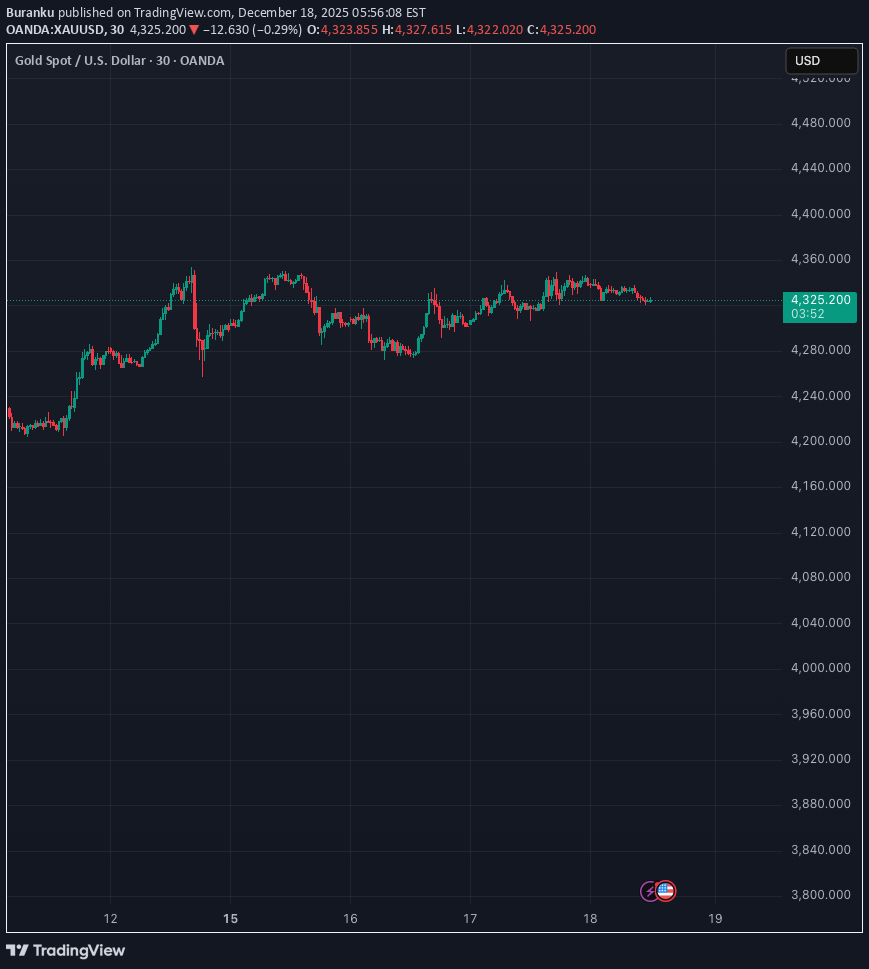
Report Summary The current tape is being driven by a three-way collision between (1) a still-easing but increasingly conditional Fed, (2) a Europe that is trying to turn immobilized Russian sovereign assets into an active funding lever for Ukraine, and (3) an abrupt U.S. escalation on Venezuela’s oil flows that re-prices “tail risk” into energy even in an otherwise surplus-leaning crude regime. The result is a market that looks selectively risk-off: U.S. equities and AI-linked beta sold off in the latest session, while oil and gold caught bids as geopolitical and legal-financial fragmentation risks rose. The S&P 500 closed at 6,721.43 (-1.16%) and the Nasdaq Composite at 22,693.32 (-1.81%), while the Dow closed at 47,885.97 (-0.47%). That cross-asset mix is important: it suggests investors are not pricing a clean “growth re-acceleration” narrative. Instead, they’re hedging two distinct uncertainties at the same time: policy uncertainty (how far the Fed can cut without reflating inflation or re-tightening financial conditions via risk premia) and geopolitical supply/settlement uncertainty (energy sanctions enforcement, shipping disruption, and reserve-currency/clearinghouse legal risk). What happened and why it matters On the U.S. policy front, financial conditions are being eased at the margin, but the Fed is signaling it is not on a one-way glide path. The December move lowered the target range for the federal funds rate to 3.50%–3.75% (and the WSJ-reported U.S. prime rate reset to 6.75%). The Fed’s own statement confirms the 25 bp cut to 3-1/2 to 3-3/4 percent. Rates markets are therefore being asked to price two things at once: a lower spot rate level and a higher probability that the Fed pauses sooner if inflation proves sticky or if financial conditions loosen “too much.” In Europe, the focus is not simply “supporting Ukraine,” but how that support is engineered. The EU is debating a “reparations loan” mechanism that effectively mobilizes immobilized Russian assets held largely at Euroclear in Belgium—borrowing against those assets to fund Ukraine, with repayment contingent on a post-war reparations outcome. In the WSJ framing, more than $245 billion in Russian assets are stranded in the EU and the proposal discussed is roughly $164 billion borrowed from Euroclear against those assets. The political constraint is that Belgium fears it could be left carrying liability if legal/retaliatory outcomes spiral. That concern is not theoretical: reporting around the debate includes legal threats and retaliation risk tied to Euroclear and the broader credibility of EU financial plumbing. In the Western Hemisphere, the U.S. escalation on Venezuela is the immediate geopolitical shock. WSJ reporting describes President Trump ordering a blockade/quarantine of sanctioned tankers, with markets explicitly linking the move to the risk of prolonged export disruptions of roughly 590,000 barrels/day (mostly destined for China). Reuters adds that Trump framed this as a “total and complete blockade” of sanctioned oil tankers entering and leaving Venezuela and also said the Venezuelan regime had been designated a “foreign terrorist organization,” which elevates both enforcement intensity and escalation risk. Market reaction snapshot The immediate price action shows a classic “risk rotation with hedges.” Equity indices fell (S&P -1.16%, Nasdaq -1.81%, Dow -0.47%). At the same time, crude and gold rose: WTI settled at $55.94 (+1.21%) and gold at $4,347.50 (+1.00%). Brent was up around $59.68 in European trade in the WSJ “stock spotlight” context. The dollar was modestly firmer on the day (WSJ Dollar Index 96.18, +0.22%), even as it remained down -6.39% YTD—consistent with a market that still sees a softer dollar regime overall but is willing to buy USD tactically on stress pulses. Rates and curve context are also telling: U.S. 2-year around 3.484% and 10-year around 4.150% in the WSJ benchmarks. The curve remains upward sloping, which is consistent with (a) term premium that doesn’t collapse because geopolitical/legal risks are rising, and (b) an expectation that the Fed can cut some, but not painlessly enough to anchor long-end yields. Strategic forecast: the next 4–12 weeks The most probable baseline is a two-track market: core “growth/AI duration” remains vulnerable to valuation discipline and policy-rate uncertainty, while real assets and defense/energy-adjacent exposures stay supported by geopolitical risk premia. This is not a simple risk-on or risk-off regime; it’s a regime where correlation rises during geopolitical headlines, but sector dispersion stays high underneath. On Venezuela specifically, the key market variable is not Venezuela’s production alone (WSJ cites roughly ~900,000 bpd production and emphasizes a sanctions-evading “shadow fleet” ecosystem), but the enforcement technology—interdiction, insurance, AIS/transponder compliance, and shipping bottlenecks. If enforcement stays tight, the market will price a fatter “Caribbean/Atlantic disruption” premium even if global balances look surplus-prone. If enforcement wobbles (legal challenges, operational limits, or negotiated carve-outs), crude can quickly mean-revert lower because the broader narrative in the same WSJ package notes crude had been pressured by surplus expectations and optimism around Russia-Ukraine talks. On Europe’s “reparations loan,” the strategic impact is bigger than the headline funding number: this is a test case for whether Western financial infrastructure (custody, settlement, reserve assets) becomes an explicit instrument of war finance. If it succeeds, it tightens Europe-Russia financial decoupling and strengthens deterrence signaling; if it backfires via legal rulings, retaliatory seizures, or perceived expropriation risk, it can quietly raise the required return on euro-area risk and modestly impair the euro’s “reserve-credibility” narrative—exactly the concern Belgium has flagged. Reuters reporting underscores that Ukraine’s financing needs are large and time-sensitive, which raises political pressure on EU leaders to find a mechanism quickly. On the Fed, the near-term center of gravity is “cut-then-pause.” Reuters coverage of the December meeting emphasizes a divided Fed and signaling consistent with limiting further near-term cuts as officials watch inflation and labor-market softening. The market implication is that downside in front-end yields is less linear from here; instead, volatility shifts toward data sensitivity and financial-conditions sensitivity, with a higher chance of short, sharp repricings. Fiscal and political implications For the U.S., an aggressive Venezuela posture is simultaneously geopolitics and domestic politics. A declared “blockade” language raises legal and diplomatic temperature, because a true blockade is classically treated as an act of war; even when officials call it a “quarantine,” markets will trade the ambiguity. WSJ reporting notes the operational scale (warships, intercept procedures, and tankers “loitering” offshore), and Reuters notes allied concern (e.g., Germany warning about destabilization). That combination raises the probability of tit-for-tat responses (Russia’s foreign ministry has already criticized the move) and raises the risk of miscalculation at sea. For Europe, using immobilized Russian sovereign assets is a fiscal-political substitute for unpopular options: either bigger direct taxpayer transfers or new joint borrowing that can be veto-blocked. This is why the reparations-loan idea keeps returning—it is designed to be politically saleable. But it also creates a precedent: once sovereign reserves are treated as contingent collateral in wartime finance, other countries may reassess how and where they hold reserves and how much exposure they tolerate to Western custodians. That’s a slow-burn issue, but it matters for long-term euro funding costs and for the competitive position of European financial infrastructure. For Venezuela, the fiscal implication is acute. WSJ notes that strict enforcement would curtail hard-currency inflows and exacerbate shortages, while referencing IMF-level inflation expectations for next year approaching ~700%. Independent reporting similarly points to IMF projections for extremely high inflation into 2026. In practical terms, tighter maritime enforcement is not just an oil story; it’s a balance-of-payments story that can spill into migration pressure, regional political instability, and a larger humanitarian burden that neighbors and the U.S. ultimately face. Risks and opportunities The principal risk is a policy-geopolitics feedback loop: tighter sanctions enforcement (Venezuela, Russia) lifts energy/commodity risk premia; higher energy prices complicate disinflation; the Fed pauses earlier or communicates more hawkishly; financial conditions tighten through risk assets; and the system becomes more headline-fragile. Even with WTI still only ~$56, the directionality matters because the market was coming from a “surplus / peace-talks optimism” narrative that had pushed crude to multi-year lows. The opportunity set is tactical and dispersion-driven. If you believe enforcement is sustained, energy (and select energy infrastructure) gets a volatility bid even in a soft-demand world, while airlines/transport can face margin pressure. If you believe Europe’s reparations-loan mechanism will land without triggering a major legal shock, European defense and security capacity spending becomes more financeable and politically durable; if you believe it will trigger reserve-credibility concerns, you position for wider euro risk premia and more support for safe-haven hedges. Key global asset impacts XAUUSD (Gold). Gold is behaving as the “legal + geopolitical + rates-volatility hedge.” With spot gold up about 1% on the session to ~$4,347.50, the market is paying for convexity against (a) escalation risk in sanctions theaters and (b) a scenario where policy easing continues but inflation uncertainty persists. The bullish path is continued geopolitical fragmentation plus Fed easing that keeps real rates contained; the bearish path is a risk-off dollar spike combined with a sharp rise in real yields. Near-term, gold is supported as long as geopolitical risk stays additive and the Fed doesn’t need to re-tighten. S&P 500. The index drawdown (-1.16% to 6,721.43) indicates equities are not simply celebrating lower policy rates; they’re repricing earnings durability and valuation sensitivity to rates/term premium. The tactical risk is that headline shocks push correlations toward 1.0 and punish crowded factors (notably AI/duration). The opportunity is selective: energy and certain “real economy” cash-flow streams can hold up better than long-duration growth if inflation or term premium re-accelerate. USDJPY. USDJPY around 155.70 in the WSJ FX table signals the yen is still not being treated as a consistent safe haven in this regime, likely because Japan’s rate normalization and global carry dynamics are competing forces. If geopolitical stress intensifies sharply, yen can still rally on risk aversion, but the path is bumpier when U.S.–Japan rate differentials remain meaningful and when dollar demand rises in stress. Watch for sudden “risk-off bid” moves lower in USDJPY on any maritime incident headline; otherwise, the carry backdrop can keep it sticky. DXY / broad dollar. The WSJ Dollar Index was slightly up on the day (+0.22%) but still down materially YTD (-6.39%), which is consistent with “structurally softer USD, tactically bid on stress.” In a regime where sanctions enforcement and settlement-system risk rise, the dollar can paradoxically benefit in the short run (liquidity preference) even if the medium-term narrative is diversification and de-risking away from USD concentration. Crude Oil. Oil is repricing geopolitics at the margin: WTI +1.21% to $55.94 and Brent around $59.68. The critical swing factor is whether the Venezuela move becomes a sustained interdiction campaign (supportive for crude) or a rhetorical spike with partial enforcement (crude fades back toward surplus fundamentals). The WSJ reference to ~590,000 bpd export disruption risk gives you the “headline number” traders will keep using. Dow Jones. The Dow’s smaller decline (-0.47%) relative to the Nasdaq fits a rotation away from long-duration tech and toward more cash-flow-anchored exposures, but it’s still not a “risk-on” print. The Dow is likely to be the relative winner in mild-stress, higher-term-premium environments, while still being vulnerable if oil spikes hard enough to hit consumers and margins.