15.12.2025 tarihinde sembol PAXG hakkında Teknik Buranku analizi

Buranku
Report 15/12/25
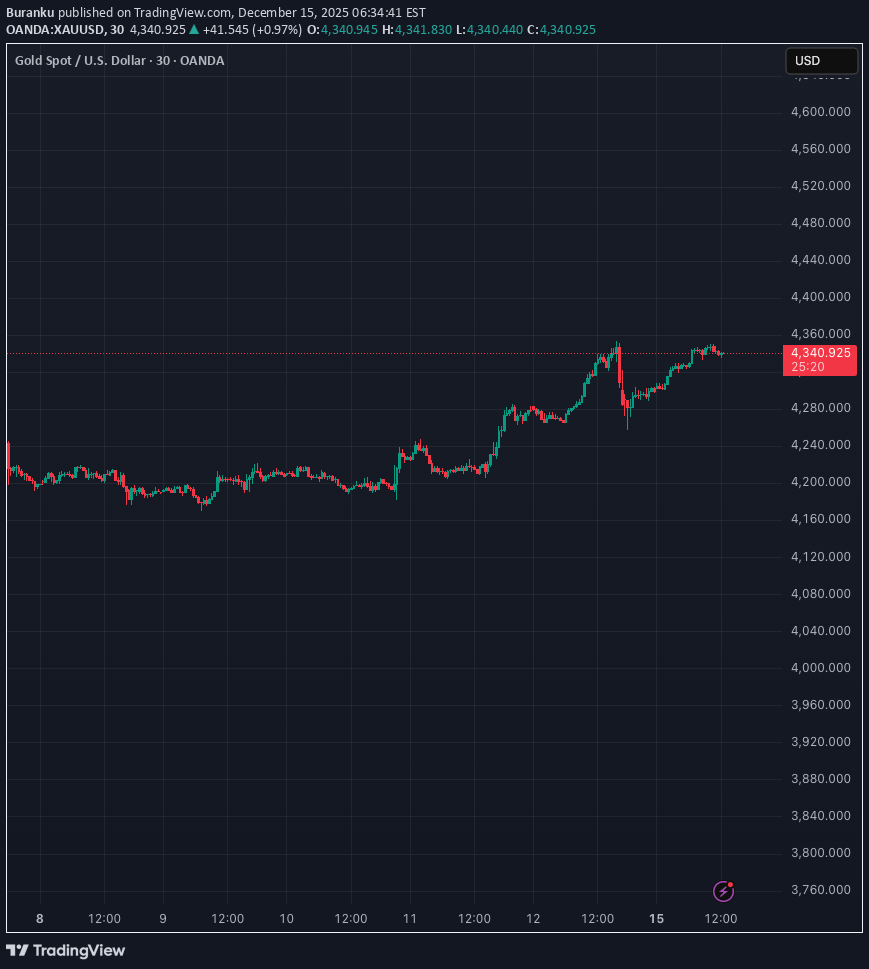
Report summary: The Federal Reserve lowered the target range to 3.50%–3.75% and the WSJ U.S. Prime Rate reset to 6.75%, confirming the beginning of an easing cycle. Equity markets responded constructively into mid-December (Dow +1.05%, S&P 500 +0.67% on 11 Dec), while the WSJ Dollar Index slipped to ~96.2 (-6.4% YTD), reflecting easier financial conditions and a modest risk-on tone. The cut fed through to money markets quickly (effective fed funds ~3.64%) and was codified in prime/discount rate changes effective Dec 11–12. Concurrently, Washington seized a tanker carrying ≈1.85 million barrels of Venezuelan crude and signaled further actions—a move that has temporarily paralyzed tanker traffic around Venezuela and tightened the “shadow fleet” bottleneck for sanctioned barrels (Russia/Iran/Venezuela). The IEA, meanwhile, sees a smaller 2025–26 oil surplus as OPEC+ pauses output hikes in 1Q and demand assumptions edge up; Brent trades a little above $61 with inventories high but logistics and sanctions keeping prices stickier than modelled. Layer on Japan’s rising yields near multi-decade highs and stepped-up U.S.–Japan security signaling (B-52/F-35 drills), and global FX/rates volatility remains a live tail risk into year-end. Market reactions (now) Equities leaned positive into and after the cut, with the S&P 500 sitting within striking distance of its high and the Dow printing fresh closing strength. The WSJ Dollar Index wobbled lower day-over-day (96.7 → 96.2), consistent with a relief bid in risk and easier U.S. rates. Money-rate tables show the policy shift rippling through o/n funding (SOFR and repo nudging down) and prime/discount rate resets, all of which help financial conditions at the margin. In energy, headline prices are surprisingly stable given record “oil on water” and sanctioned barrels; analysts attribute the stickiness to sanctions frictions, longer routes, and China’s strategic stockpiling—plus uncertainty over how quickly “dark” barrels can find end buyers. Strategic forecasts Monetary policy: The Fed has initiated a “cut-and-cap” style easing. Options markets and rate-probability trackers embedded in WSJ coverage imply investors are nudging up the probability of multiple 2026 cuts, though the path is data-dependent. Base case is a shallow U.S. easing path that sustains a mildly weaker dollar and flatter U.S. curve into 1H26, barring upside inflation surprises. Geopolitics/energy: Even sporadic U.S. seizures could depress Venezuela’s exportable supply and widen discounts, tightening available heavy barrels and intermittently lifting refined product cracks. If sanctioned flows re-route to willing buyers via ship-to-ship transfers, the crude headline balance stays comfortable, but logistics premiums persist, keeping Brent in a higher-than-warranted range versus inventory math. Asia/rates: Japan’s 10-year hovering near ~1.8–1.9% keeps upward pressure on global term premia during stress episodes and complicates USDJPY if the MoF leans against FX volatility. Security coordination with the U.S. adds a geopolitical risk premium to the region if China-Taiwan tensions flare. Fiscal & political implications The Fed’s move lowers debt-service costs across U.S. sectors and marginally improves refinancing math for duration-heavy balance sheets. Lower prime eases consumer/SMB credit strains and supports housing turnover via mortgage-rate drift, though credit availability remains tight. In energy policy, the U.S. campaign against shadow flows raises diplomatic friction with countries hosting or financing the gray fleet and may force EU/Asian refiners to navigate tighter compliance—politically salient if fuel prices jump suddenly. Risks Near-term, the biggest market risk is a stop-and-go oil shock if seizures scale and a risk-off dash strengthens the dollar despite Fed easing. A second is a “Japan spillover”: a sharp JGB move that jars global rates/FX and prompts disorderly USDJPY swings. A third is growth disappointment that turns today’s soft landing into an earnings-growth air pocket, re-widening credit spreads after December’s relief. Probabilities for a faster Fed path are inherently linked to inflation prints; WSJ’s money-rate backdrop still shows core CPI running ~3% YoY in the latest table—a reminder the last mile isn’t done. Opportunities Duration and quality credit screen favorably into a gentle U.S. easing path; WSJ commentary notes investors adding duration as cut odds for 2026 improve. Select energy equities with exposure to heavy-sour barrels and complex refining may benefit from widening differentials/logistics premia even if spot crude remains range-bound. In equities, beneficiaries of lower discount rates and stable growth (U.S. large-cap quality, AI-infrastructure adjacencies) retain support, while banks and interest-sensitive cyclicals benefit from easier funding—provided credit quality holds alongside employment. Asset-by-asset impact XAUUSD (Gold). Directionally supported by lower real rates and a softer dollar; geopolitical bid from Venezuelan tensions adds tail risk. Baseline bias is modestly higher with pullback risk on any USD spike. Monitor DXY and real-yield ticks; a durable break higher in DXY would cap the move. S&P 500. The cut extends the soft-landing narrative and compresses equity risk premium near the highs; path forward hinges on 4Q/1Q earnings breadth. A stickier oil/logistics premium would nick margins for energy-intensive sectors but help refiners and midstream. Near-term tone stays constructive while the dollar stays subdued and funding eases. Dow Jones. More value and industrials exposure benefits from easier domestic credit and capex resilience. Watch for upside in defense/energy logistics if tanker tensions persist; downside if a dollar rebound tightens global financial conditions. USDJPY. Two-way risk increases: Fed easing is yen-supportive at the margin, but higher JGB yields and any MoF jawboning/intervention risk can trigger sharp squeezes. Security headlines add volatility. Base case is choppy consolidation rather than a trend break until BoJ policy clarity improves. DXY (broad USD). The index has slipped as cuts began; further drift lower is plausible if growth stays decent and inflation cools, but any shock (oil spike, geopolitics, Japan rates tantrum) can force a dollar rebound. Tactical bias: sell rallies while the policy-rate differential narrows—tight stops given event risk. Crude Oil (Brent/WTI). Headline balances look loose, yet sanctions/logistics are preventing deeper price declines; the U.S. seizure program is the wild card. Expect a choppy, headline-sensitive range near low-$60s Brent, with upward spikes on enforcement days and fades as barrels re-route to end buyers or Chinese storage. What to watch next Watch the pace and frequency of U.S. maritime enforcement around Venezuela and any EU/Asian compliance echoes; a sustained disruption raises the probability of transient refined-product tightness. Track JGB auctions and BoJ communications for signs of a firmer ceiling on yields; disorderly moves would spill into global FX and long-end U.S. rates. Finally, watch the WSJ Dollar Index and funding prints (SOFR/repo) for confirmation that easier policy is filtering cleanly into money markets without unintended tightness.