تحلیل تکنیکال Swissquote درباره نماد PAXG در تاریخ ۱۴۰۴/۸/۱۲

Swissquote
سقف طلا در 4381 دلار: پایان چرخه صعودی یا فقط یک توقف موقت؟
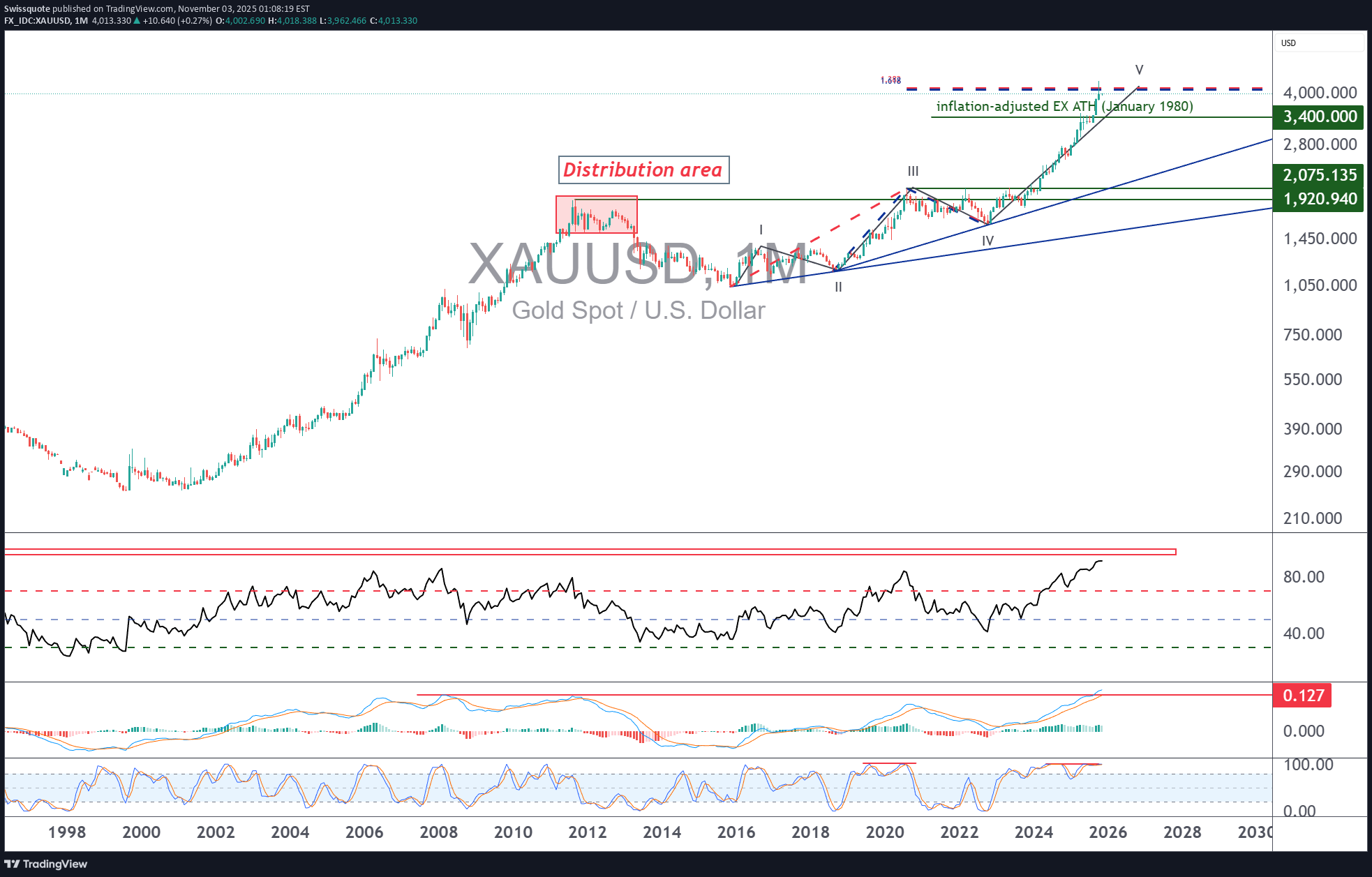
Has the price of gold reached its final bullish cycle high at $4,381 during the trading session of Monday, October 20? That session marked the end of an upward inertia phase in precious metals prices, triggering the first retracement since mid-August. However, a retracement does not necessarily mean a final cycle top or the start of a long-term bearish trend. To confirm that gold has made its annual top this October in the commodities market, several technical and fundamental conditions must be met — and at this stage, they are not. 1) To confirm a major cycle top, a strong resistance level and a clear bearish reversal pattern must be observed Looking back at gold’s price history, we can refer to the long distribution phase of 2011–2012, which concluded a bullish trend that had begun at the start of the century. This was followed by a four-year bear market, before a new long-term uptrend began in January 2016. What about the current long-term technical setup? Monthly chart data provide insight into the broader cycle. Gold has been building its fifth bullish wave since the breakout above its former all-time high in March 2024, already exceeding several theoretical price targets based on Fibonacci extensions. The $4,300 region aligns with two major extensions, including the 1.618 “golden ratio” extension of wave 3. However, that alone is not enough to confirm that the cycle top occurred at $4,381. At this stage, there is no distribution pattern or major support break. A drop below $3,400 would be a strong signal of a completed bullish cycle. 2) Gold’s cyclical top will occur when the US dollar confirms a medium-term bullish reversal Gold’s cyclical top will coincide with the moment the US Dollar (USD) establishes a sustained bullish reversal. Gold and the dollar usually move in opposite directions: a stronger dollar reduces the appeal of gold for international investors. Once the dollar confirms an upward trend reversal, capital will progressively rotate away from gold — signaling the end of the metal’s bullish phase. The chart below shows the weekly candlesticks of the US Dollar Index (DXY) against a basket of major currencies, highlighting the bullish reversals seen in 2018 and 2021. 3) Gold’s cyclical top will be reached when outflows dominate in GOLD ETFs The gold cycle will top out when capital outflows from gold-backed ETFs become dominant. Inflows into these funds usually reflect investor appetite for the metal. When these inflows slow and reverse, it shows a gradual disengagement from gold’s financial demand — which has played a major role in its 2025 price rally. This shift marks the maturity of the bullish phase. Therefore, the dominance of ETF outflows is an early indicator of an impending gold cycle reversal. For now, according to World Gold Council data, that situation has not yet materialized. DISCLAIMER: This content is intended for individuals who are familiar with financial markets and instruments and is for information purposes only. The presented idea (including market commentary, market data and observations) is not a work product of any research department of Swissquote or its affiliates. This material is intended to highlight market action and does not constitute investment, legal or tax advice. If you are a retail investor or lack experience in trading complex financial products, it is advisable to seek professional advice from licensed advisor before making any financial decisions. This content is not intended to manipulate the market or encourage any specific financial behavior. Swissquote makes no representation or warranty as to the quality, completeness, accuracy, comprehensiveness or non-infringement of such content. The views expressed are those of the consultant and are provided for educational purposes only. Any information provided relating to a product or market should not be construed as recommending an investment strategy or transaction. Past performance is not a guarantee of future results. Swissquote and its employees and representatives shall in no event be held liable for any damages or losses arising directly or indirectly from decisions made on the basis of this content. The use of any third-party brands or trademarks is for information only and does not imply endorsement by Swissquote, or that the trademark owner has authorised Swissquote to promote its products or services. Swissquote is the marketing brand for the activities of Swissquote Bank Ltd (Switzerland) regulated by FINMA, Swissquote Capital Markets Limited regulated by CySEC (Cyprus), Swissquote Bank Europe SA (Luxembourg) regulated by the CSSF, Swissquote Ltd (UK) regulated by the FCA, Swissquote Financial Services (Malta) Ltd regulated by the Malta Financial Services Authority, Swissquote MEA Ltd. (UAE) regulated by the Dubai Financial Services Authority, Swissquote Pte Ltd (Singapore) regulated by the Monetary Authority of Singapore, Swissquote Asia Limited (Hong Kong) licensed by the Hong Kong Securities and Futures Commission (SFC) and Swissquote South Africa (Pty) Ltd supervised by the FSCA. Products and services of Swissquote are only intended for those permitted to receive them under local law. All investments carry a degree of risk. The risk of loss in trading or holding financial instruments can be substantial. The value of financial instruments, including but not limited to stocks, bonds, cryptocurrencies, and other assets, can fluctuate both upwards and downwards. There is a significant risk of financial loss when buying, selling, holding, staking, or investing in these instruments. SQBE makes no recommendations regarding any specific investment, transaction, or the use of any particular investment strategy. CFDs are complex instruments and come with a high risk of losing money rapidly due to leverage. The vast majority of retail client accounts suffer capital losses when trading in CFDs. You should consider whether you understand how CFDs work and whether you can afford to take the high risk of losing your money. Digital Assets are unregulated in most countries and consumer protection rules may not apply. As highly volatile speculative investments, Digital Assets are not suitable for investors without a high-risk tolerance. Make sure you understand each Digital Asset before you trade. Cryptocurrencies are not considered legal tender in some jurisdictions and are subject to regulatory uncertainties. The use of Internet-based systems can involve high risks, including, but not limited to, fraud, cyber-attacks, network and communication failures, as well as identity theft and phishing attacks related to crypto-assets.